
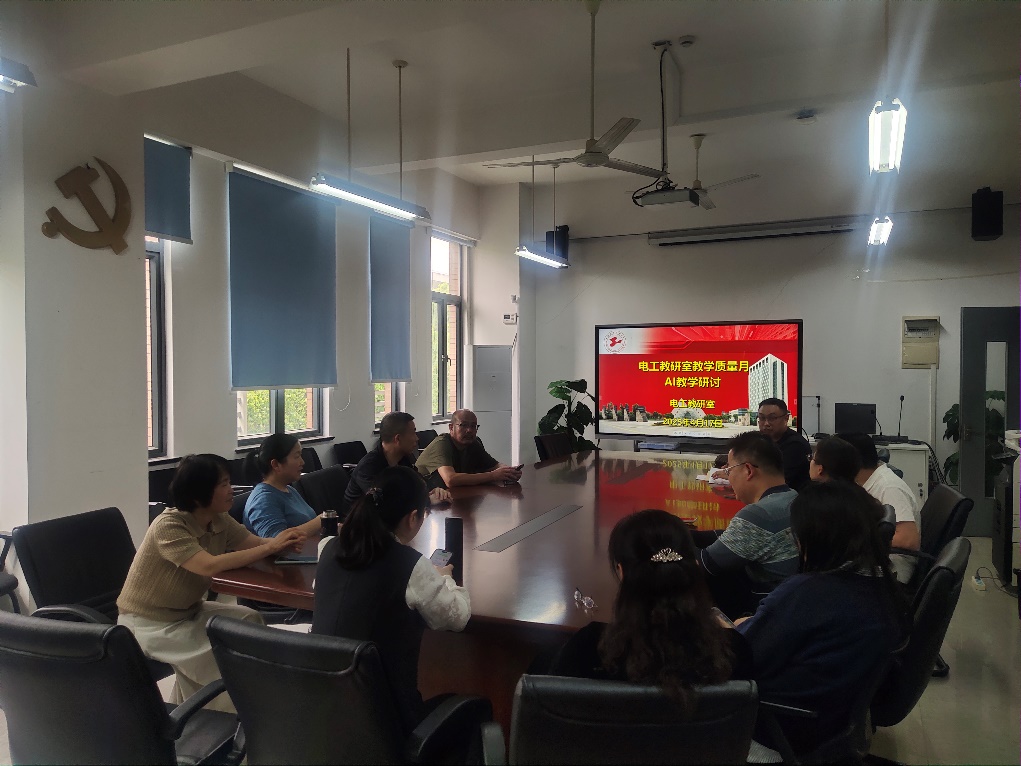
At 14:00 on the afternoon of April 17th, all faculty members of the Electrical Engineering Teaching and Research Section convened a teaching seminar themed "AI Empowers Teaching" in Room 1438 of the Practical Training Building. During the seminar, several pioneering teachers who have pioneered AI-driven teaching reforms shared their valuable experiences and insights.
Young Teacher Yao Yao stated: "Rather than merely leveraging AI's empowering potential, what we need more is effective collaboration with AI. In course instruction, we need to engage in effective interactions with AI, and the primary vehicle for these interactions is 'prompts'. Therefore, the ability to craft high-quality prompts is essential. Accurately extracting keywords related to objectives, backgrounds, and tasks enables AI tools to quickly align with our needs, thereby boosting work efficiency. Additionally, teachers' professional knowledge reserves determine their ability to harness technology effectively, making the continuous consolidation of professional foundations imperative."
Chen Dexin, Deputy Director of the Teaching and Research Section, mentioned that the AI teaching assistant integrated in Xuexitong can provide robust support for question compilation. When creating questions, after uploading relevant screenshots, the assistant can accurately recognize not only text but also physical quantities, presenting them in a standardized format. This effectively eliminates the tedious manual editing workload and reduces the risk of human error. Meanwhile, Chen also pointed out a limitation of the Xuexitong AI teaching assistant: formatting inconsistencies may occur when content is copied and pasted into the question bank, requiring manual sorting and organization to address.
Associate Professor He Zhimin, a core teacher of the Teaching and Research Section, emphasized a key principle for AI-assisted teaching: "The key lies not in asking AI what to do, but in clearly instructing it on what needs to be done." He illustrated this point with a specific example of a well-structured prompt:
Role: Assume the identity of a professional *Electronic Technology* instructor with specialized expertise in the application of operational amplifiers in signal processing.
Content Scope: Focus on "Applications of Operational Amplifiers in Signal Operation and Comparison", covering both linear and nonlinear applications of operational amplifiers.
Question Requirements: Design 2 fill-in-the-blank questions. Each question stem must be integrated with specific operational amplifier application scenarios in engineering, and contain 7 blanks (represented by long horizontal lines). The content for each of the 7 blanks must be distinct, with students required to fill in specific types of operational amplifier applications. Answers should be presented separately after each corresponding question stem.
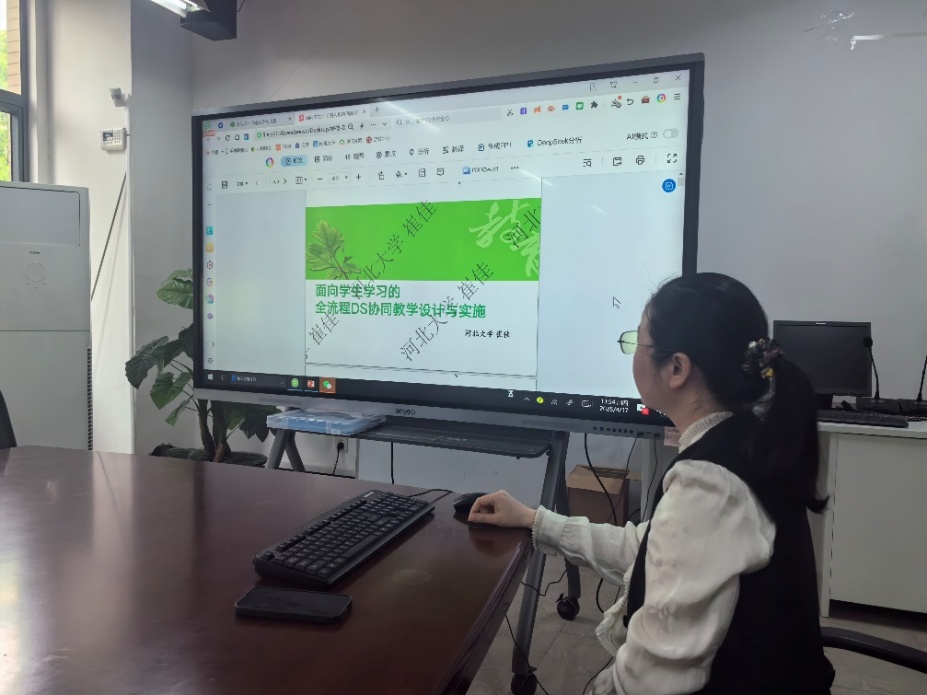
Other teachers from the Teaching and Research Section, including Zhang Zhixiong and Wang Jinghua, also shared their questions and proposals during the discussion. They expressed their commitment to proactively familiarizing themselves with AI tools and progressively integrating these technologies into their teaching practices to continuously enhance teaching quality.